

Al Alam’s journal met with his artist’s artist’s painter and calligrapher by Marocain Hachem Amzil in his artistic series “Sira bil Alwan” (Parcours and couleurs).
The artistic series «Sira bil Alwan», which accueille quotidiennement of one or one of the Maroc artists and several Arab artists in the pages of the Marocain Al Alam journal, offers a space for expression and the discovery of universal artists. She invites you to explore plastic artists, explore creative designs, and explore artistic images. This is an occasion for a number of socioprofessional realities, advances and aspirations. It is a great pleasure to welcome Mohamed Bachkar to this beautiful initiative and to bring it to artists and art. Autumn, next to Hachem Amzil, artist and calligraphy contemporain Marocain… (Read more)
ABOUT HACHEM AMZIL
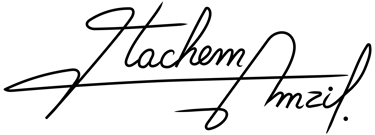
Hachem Amzil
9/18/20264 min read


My artistic talent began to develop at an early age in an artistic environment, shaped by the influence of my father, the painter and calligrapher Mohamed Amzil. For me, art began with observation before becoming a practice. I have always been attentive to the details and colors surrounding me. I particularly remember that, at around the age of four, I stopped in front of a painting depicting a warrior fighting a lion. I noticed that the lion’s paw seemed unusually long, an observation that surprised my father and marked one of the earliest signs of my natural inclination toward art and visual perception.
After obtaining my Baccalaureate in Applied Arts, I continued to develop my artistic and visual education through international certifications and training programs in the fields of art, design, and event management. These experiences helped broaden my artistic vision and deepen my understanding of the importance of bringing together authenticity and modernity.
My artistic approach consists of liberating the Arabic letter from its linguistic function and transforming it into an autonomous visual entity, where movement, color, and space intertwine to create an artistic universe that invites contemplation and inner serenity.


“My artistic approach consists of liberating the Arabic letter from its linguistic function and transforming it into an autonomous visual entity.”
I am delighted to announce the publication of an article dedicated to my artistic journey in the Moroccan newspaper Al Alam, as part of its feature series “Sira bil Alwan” (A Journey in Colors), in the Friday, September 18, 2026 edition.
The article is entitled:
“My artistic approach consists of liberating the Arabic letter from its linguistic function and transforming it into an autonomous visual entity.”
My sincere thanks and appreciation go to journalist Mohamed Moatassim for his dedication and efforts in following the work of visual artists and bringing their artistic approaches and experiences to light through his articles, reports, and various programs.
I would also like to thank Al Alam newspaper for this opportunity and for its interest in highlighting Moroccan artistic experiences.
I consider myself part of the new generation of Moroccan artists seeking to renew Morocco’s visual heritage through a contemporary approach inspired by Arabic calligraphy and abstraction, with a distinctly modern sensibility. I do not view art as merely an extension of tradition, but rather as a space for reinterpreting Moroccan visual identity through a universal language that brings together authenticity and contemporary thought.
Within today’s artistic landscape, I aspire to offer a visual experience that transforms the Arabic letter into a living element, moving beyond its reading function to become a medium of sensation and visual rhythm. My artistic presence was recently strengthened by my selection among twelve artists to represent Morocco and Africa at an international exhibition in Shanghai, China. On this occasion, two of my artworks were acquired by the museum and institute. I consider this recognition a source of motivation to further develop my artistic project and strengthen its place within the contemporary art scene.


My artistic practice is rooted in the movement of gestural calligraphic expressionism, in which I approach the Arabic letter as a visual energy and a free-flowing rhythm, far beyond its reading function. What fascinates me about art is its ability to express personal sensitivity and transform inner emotions into chromatic and gestural compositions that convey calm and psychological balance.
In my work, I constantly seek to create spaces that offer viewers a sense of well-being and contemplation. This is why I consider art a form of visual and inner therapy. I am also particularly interested in movement and light within the composition, as they breathe life into the canvas and give it a rhythm of its own.
The defining characteristics of my work therefore lie in the fusion of the Arabic letter with contemporary abstraction, through compositions built around color harmony and a sense of serene expression, while leaving viewers entirely free to interpret what they see.
I believe that artificial intelligence can be a positive tool, opening up new possibilities for visual artists. However, it can also pose a risk to younger generations if they rely on it from the very beginning, without first developing genuine creative and intellectual skills.
Creativity does not originate from machines; it grows out of experience, observation, and continuous learning. It is therefore essential to encourage children, in the first instance, to develop their capacity for innovation, as well as their intellectual and visual abilities, so that they can build their own tools for artistic expression. Only then will they be truly equipped to use artificial intelligence consciously and thoughtfully.


Today, Morocco’s visual arts scene is experiencing a rich and diverse artistic dynamism, reflecting a wide range of creative experiences and aesthetic perspectives. However, it continues to face challenges, particularly the limited development of artistic appreciation and sensitivity among certain segments of the public.
The difficulty lies neither in a lack of creativity nor in an absence of talent, as Morocco is home to many artists capable of producing works that convey profound human and universal dimensions. Rather, the challenge lies in the insufficient development of a genuine visual culture capable of keeping pace with this artistic evolution.
It is therefore essential to strengthen art education within schools and expand access to exhibitions, as well as cultural and media programmes that bring art closer to society. The more the public’s aesthetic awareness develops, the more confidently Moroccan visual arts will be able to continue evolving and engage with the international art scene, while preserving their cultural identity.
It is much like the journey of a carpenter who begins by working with a hammer and a hand saw, gradually developing craftsmanship and a sensitivity to materials, before moving on to a power saw to refine the quality of their work and increase productivity. The key, therefore, is to master the fundamentals first before relying on new technologies.
Contact
Social networks
Follow us
hachemamzil@hachemart.com
© 2025. All rights reserved.